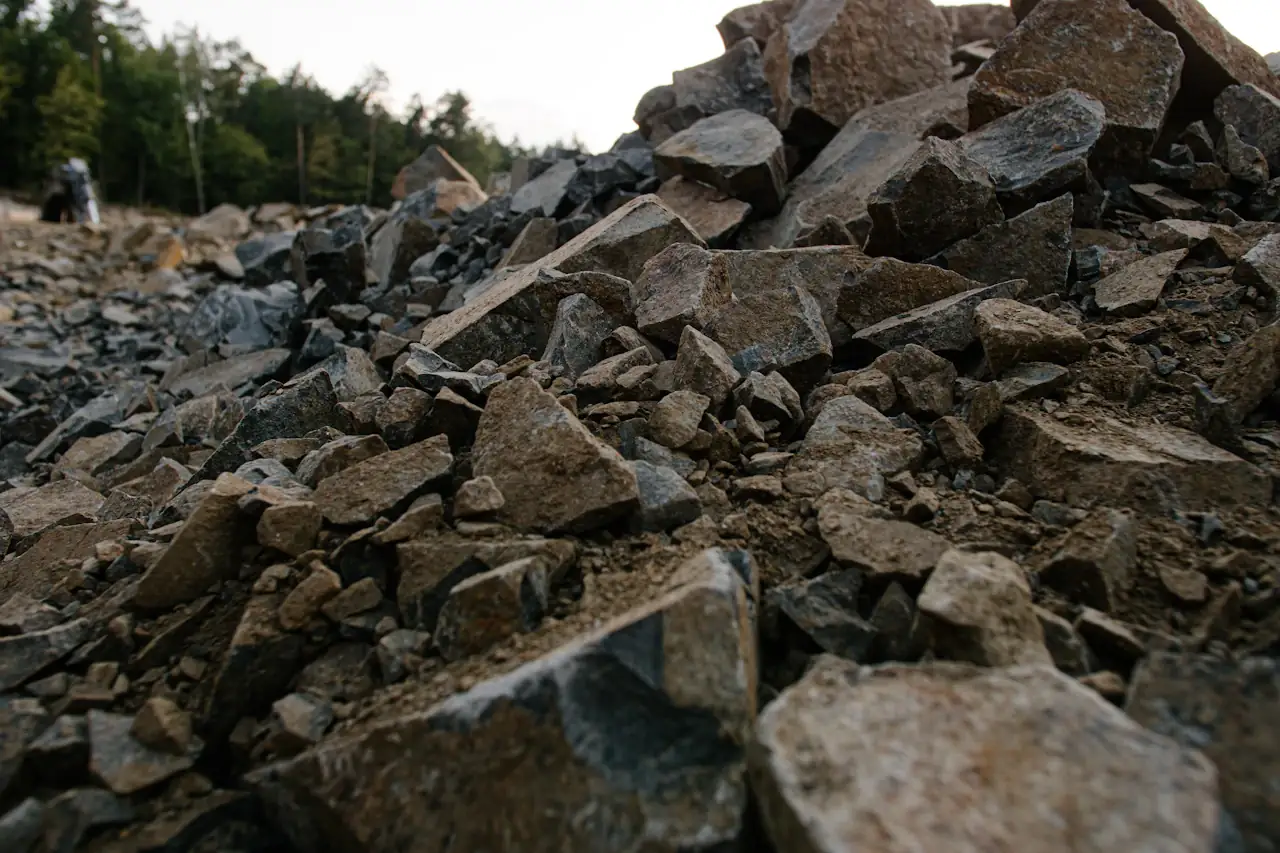
Choosing Aggregate for Asphalt: Selection Criteria for Asphalt Mixes
Aggregate forms the main part of an asphalt mix. Learn how fractured faces, hardness, cleanliness and adhesion to bitumen shape asphalt performance.

Mineral filler forms a mortar with bitumen that decides asphalt stability. Learn ASTM D242 limits, the dust-to-binder ratio and how filler type affects a mix.
Filler is a small share of an asphalt mix by weight, but its effect is far larger than its share. These very fine particles form a mortar with bitumen that binds the coarser particles together.
ASTM D242 sets these limits for mineral filler:
| Sieve | Percent passing |
|---|---|
| 600 µm | 100 |
| 300 µm | 95 to 100 |
| 75 µm | 70 to 100 |
The standard also limits the filler’s plasticity index to a maximum of 4. See the details on the stone powder page.
The amount of filler means little on its own and must be measured against the bitumen. In Superpave design, this ratio is usually controlled between 0.6 and 1.2. Too little leaves a soft mix prone to rutting; too much makes it brittle and hard to place.
Limestone powder is the most common filler. Hydrated lime is also sometimes used to improve bitumen adhesion to the stone. Filler must be dry and free of lumps to disperse evenly in the mix. Clay in the filler increases moisture sensitivity.
Filler grading is checked by sieve analysis with suitable washing, and plasticity by Atterberg limits. For the full picture of asphalt materials, see Choosing aggregate for asphalt.
Related products
Related articlesRelated
Aggregate forms the main part of an asphalt mix. Learn how fractured faces, hardness, cleanliness and adhesion to bitumen shape asphalt performance.
A drainage layer must pass water and hold back soil. Learn Terzaghi's filter criteria, material cleanliness and how to place French drains and geotextiles.
Riprap stability depends on stone size, durability and the filter layer. Learn how flow velocity relates to stone weight, what the filter does and how to place it.
Record the material type, approximate volume and delivery location so availability and terms can be reviewed.