The Los Angeles Abrasion Test: How Well Does Rock Resist Impact and Wear?
The Los Angeles test measures aggregate resistance to abrasion and impact. Learn ASTM C131 and C535, how percent loss is calculated and what it means.
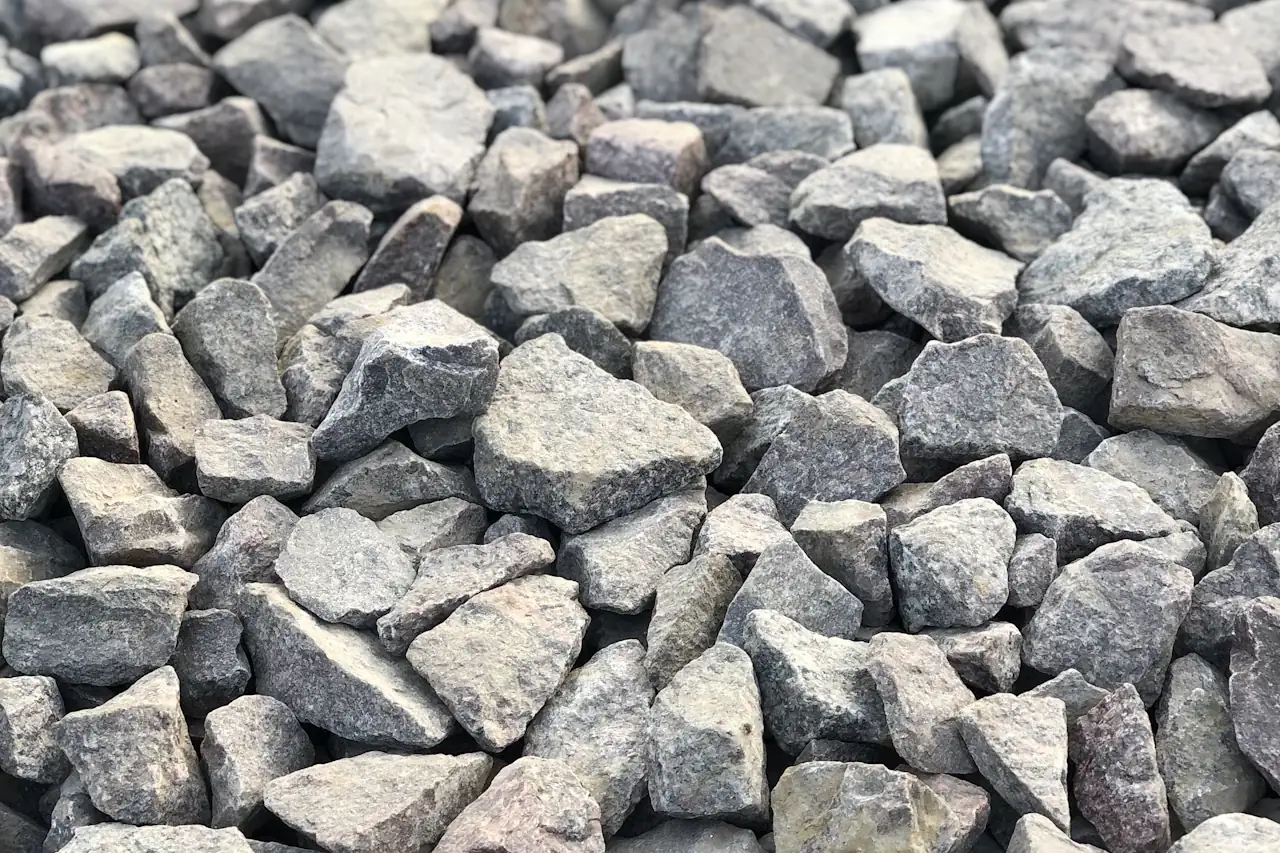
Flat and elongated particles reduce compaction and workability and break under load. Learn how they are measured, what they do and how production reduces them.
Two aggregate samples with the same grading curve can behave very differently. A main reason is particle shape. A flat particle is thin, an elongated one is long, and both are far from a cubical particle.
ASTM D4791 measures the dimensional ratios of each particle with a proportional caliper. Ratios such as 3:1 or 5:1 are chosen according to the project specification. In European standards, the flakiness index is determined by EN 933-3 using slotted sieves. These methods do not give the same result, so the test method must be stated when comparing numbers.
Particle shape is largely made at the crushing stage:
Impact crushers usually produce more cubical particles. See Types of crusher.
The limit depends on the use and is usually stricter in road and asphalt specifications. To find it, see the project specification and the reference publications on the quality and standards page.
Related products
Related articlesRelated
The Los Angeles test measures aggregate resistance to abrasion and impact. Learn ASTM C131 and C535, how percent loss is calculated and what it means.
A grading curve shows how particle sizes are distributed. Learn continuous, gap and uniform grading and the coefficients of uniformity and curvature.
A guide to common aggregate tests, including grading, sand equivalent, Los Angeles abrasion, soundness and absorption, and how to interpret their results.
Record the material type, approximate volume and delivery location so availability and terms can be reviewed.