Flat and Elongated Particles: Why Particle Shape Matters
Flat and elongated particles reduce compaction and workability and break under load. Learn how they are measured, what they do and how production reduces them.
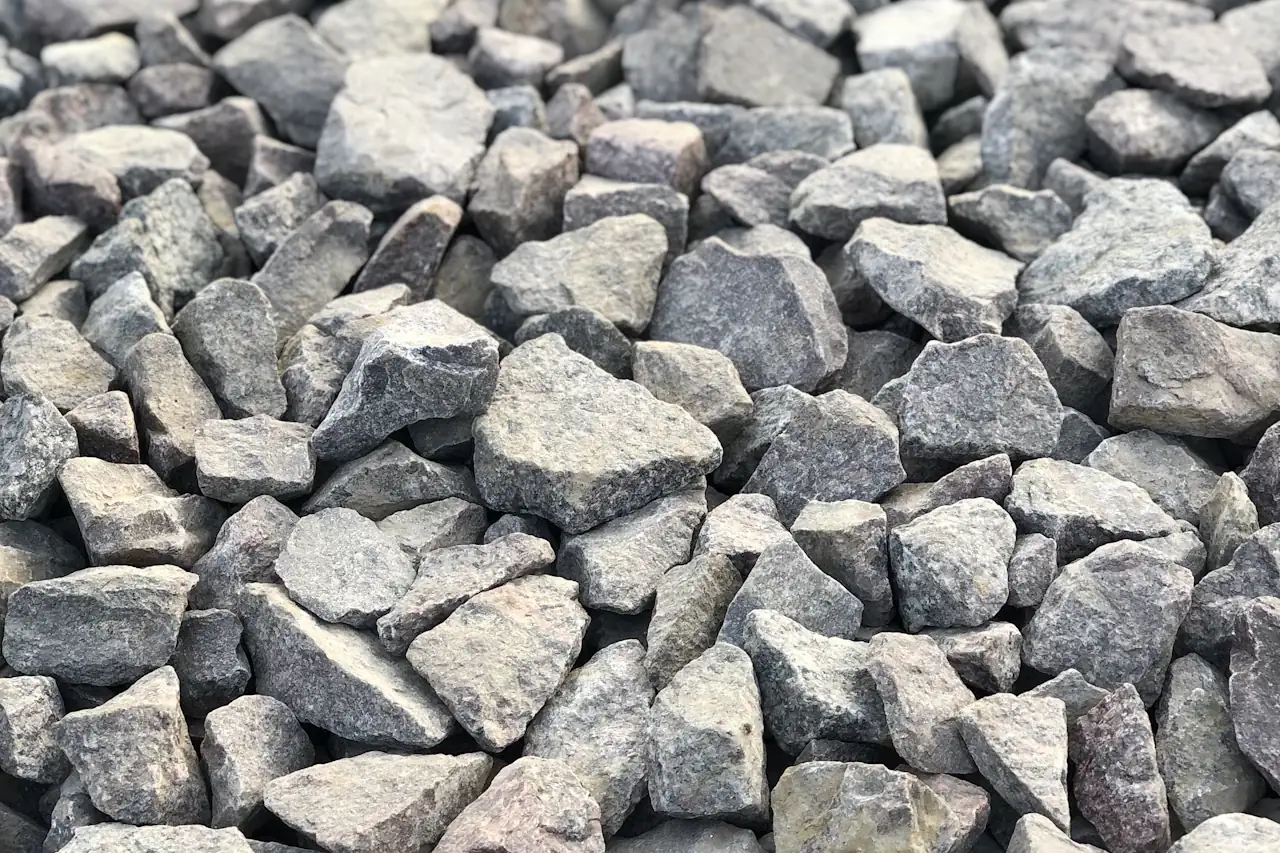
The Los Angeles test measures aggregate resistance to abrasion and impact. Learn ASTM C131 and C535, how percent loss is calculated and what it means.
Over its life an aggregate meets impact and abrasion again and again: during loading, under rollers and then under traffic. The Los Angeles abrasion test is the most common way of predicting this behaviour.
A sample of specified grading goes into a rotating steel drum with steel spheres. The drum turns 500 revolutions in C131 and 1,000 in C535. A shelf inside the drum lifts and drops the spheres and material, so the sample receives impact and abrasion at once.
After rotation the material is sieved on the 1.70 mm sieve. Percent loss equals the difference between the original mass and the mass retained on the sieve, divided by the original mass, times 100. A lower number means tougher rock.
ASTM C33 shows a limit of 50 percent for many classes of concrete coarse aggregate, but the limit for a project depends on its use and specification. Road surface layers usually have stricter limits.
The test does not show the rock’s compressive strength or its behaviour under freeze-thaw cycles. Durability against weathering is measured by the sulfate soundness test. One sample also represents only that part of the quarry, and the test should be repeated as the working face moves.
For the use of these results in road layers, see Base and subbase.
Related products
Related articlesRelated
Flat and elongated particles reduce compaction and workability and break under load. Learn how they are measured, what they do and how production reduces them.
A grading curve shows how particle sizes are distributed. Learn continuous, gap and uniform grading and the coefficients of uniformity and curvature.
A guide to common aggregate tests, including grading, sand equivalent, Los Angeles abrasion, soundness and absorption, and how to interpret their results.
Record the material type, approximate volume and delivery location so availability and terms can be reviewed.