Choosing Sand for Mortar and Plaster: Cracking, Adhesion and Workability
Unsuitable sand leads to cracked, detached plaster. Learn ASTM C144 limits, how fines and clay act, and how to select sand for masonry mortar and plaster.
Natural and crushed sand compared on particle shape, water demand, workability and strength, with selection notes for concrete, mortar and asphalt.
Choosing between natural and crushed sand is one of the most common questions in mix design. Neither is better in absolute terms; each has properties that become an advantage or a limit in a given application.
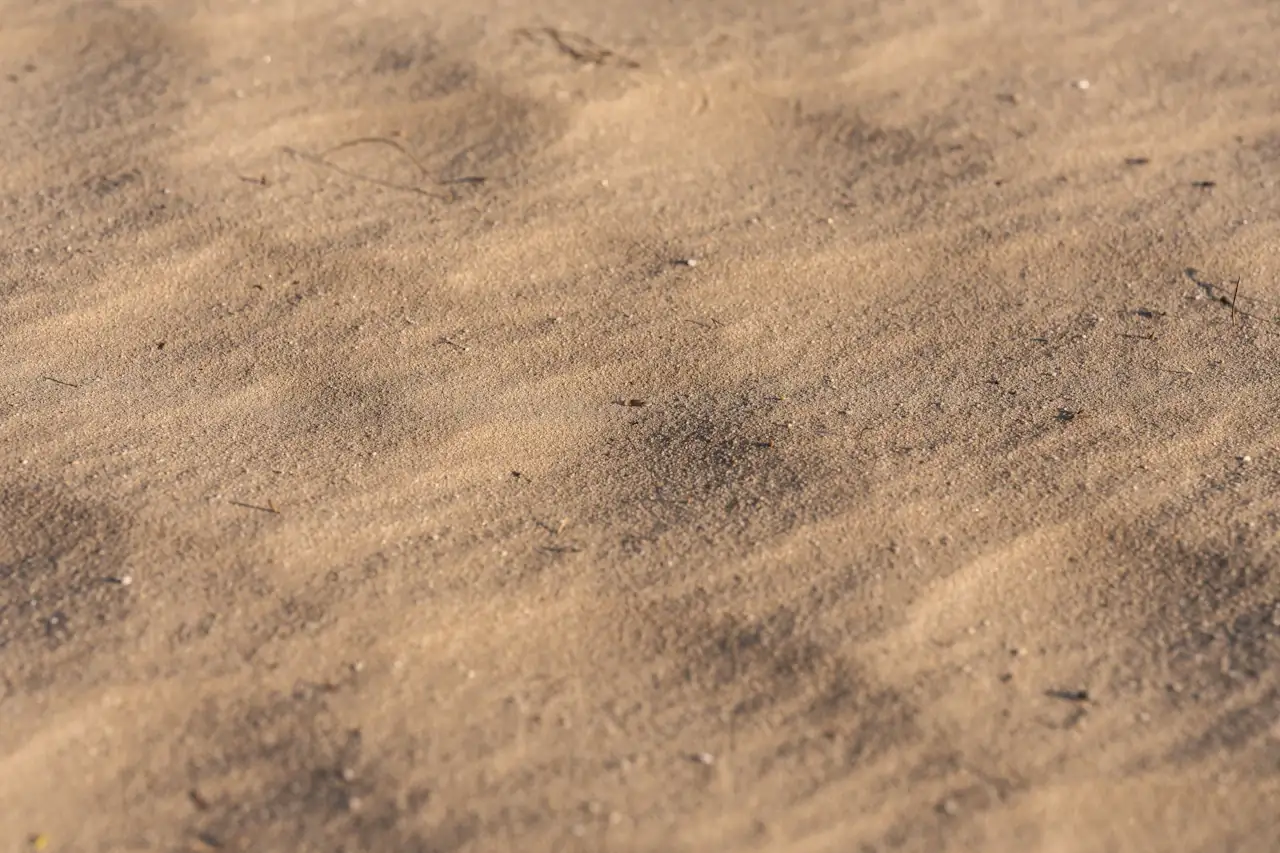
Natural sand results from the erosion of rock over time and is taken from alluvial deposits. Its particles are rounded with fairly smooth surfaces. Crushed sand comes from crushing rock in a plant and has angular particles with rough surfaces.
| Property | Natural sand | Crushed sand |
|---|---|---|
| Particle shape | Rounded | Angular |
| Surface texture | Fairly smooth | Rough |
| Fresh concrete workability | Usually better | Needs mix adjustment |
| Bond with cement paste | Good | Usually stronger |
| Fines | Mainly silt and clay | Mainly stone dust |
In fresh concrete, rounded particles slide past each other more easily and reach the target workability with less water. Crushed particles have more specific surface and may raise the water demand of the mix.
On the other hand, the rough surface of crushed sand strengthens the mechanical bond with cement paste. With a suitable mix design and a plasticizing admixture, this sand can serve structural concrete well.
The nature of the fines differs between the two. Fines in natural sand may be clayey and harm water demand and admixtures. Fines in crushed sand are often stone dust and, within limits, can help fill voids. This is why one number is not enough to control fines, and the sand equivalent test gives useful information about their nature.
The final measure is how the material tests in the actual mix design. Before use, compare a sample with the project specification and make a trial mix to see how it really behaves.
Related products
Related articlesRelated
Unsuitable sand leads to cracked, detached plaster. Learn ASTM C144 limits, how fines and clay act, and how to select sand for masonry mortar and plaster.
Maximum gravel size depends on member dimensions, bar spacing and placement method. Learn the common rules and how this choice affects cement use and workability.
Sand equivalent shows the ratio of sand to clay-like fines by a quick method. Learn the ASTM D2419 procedure, the calculation and the limits of interpreting it.
Record the material type, approximate volume and delivery location so availability and terms can be reviewed.